


TL;DR
Most reps lose their week to admin work, not laziness. Actual selling gets less than a third of their time. The rest disappears into data entry and app-switching. If you want real gains this year, resist the urge to buy another tool. Consolidate instead. One platform holding your CRM, automation, and lead engagement will beat five logins that barely speak to each other.
Table of Contents
- What Does Sales Productivity Actually Mean in 2026?
- Sales Productivity vs. Sales Efficiency (Yes, There’s a Difference)
- Why Sales Teams Keep Losing Productivity in 2026
- How to Measure Sales Productivity (Five Numbers Worth Watching)
- The Sales Productivity Tools Worth Paying For in 2026
- How to Improve Sales Productivity Without Adding Headcount
- The Mistakes That Quietly Drain Sales Productivity
- The Case for One Platform Instead of Five
- Sales Productivity by the Numbers (2026 Data Table)
- FAQs
- Where to Go From Here
1. What Does Sales Productivity Actually Mean in 2026?
No two sales managers seem to define sales productivity the same way. Some point to call volume. Others point to closed deals. The real definition is simpler than either: it’s how efficiently your team turns time and resources into revenue.
Here’s the part most people miss. A busy rep and a productive rep can look identical from across the office. Both are on the phone. Both have full calendars. But one of them is closing deals, and the other is just generating activity. The gap between those two reps usually comes down to where their hours actually go, and that’s rarely obvious until you measure it.
According to Salesforce’s State of Sales report, reps only spend around 12 hours of a 40-hour week on tasks that directly touch selling. The rest gets swallowed by data entry, quote building, and internal reporting. Improving productivity, then, mostly means winning that lost time back.
2. Sales Productivity vs. Sales Efficiency (Yes, There’s a Difference)
These two terms get used interchangeably in a lot of sales meetings, and that sloppiness has a cost. Treat them as identical and you end up solving the wrong problem.
Productivity is about output. How much revenue did the team generate? How many deals closed? Efficiency is a different question entirely. It asks how well the team used its time, budget, and tools to get there.
Here’s an example that makes the difference click. Picture a rep who closes six figures in deals every quarter but sends triple the emails and burns through twice the calendar to do it. That rep is productive. Efficient? Not really. Teams built to last keep an eye on both. A leaderboard only shows one of them.
3. Why Sales Teams Keep Losing Productivity in 2026
There has never been more sales technology on the market, so quota attainment should be climbing. Instead it keeps slipping, year after year, and a few analysts have taken to calling the whole situation a productivity paradox. All that software, and less to show for it.
Three things are driving that gap.
Start with tool sprawl. The average seller now bounces between close to ten different platforms just to push a single deal forward. Nearly half of reps, 42%, say they feel overwhelmed by their own tech stack, and that feeling isn’t just an annoyance. According to Salesforce’s sales research, sellers who report feeling overwhelmed by their tools are 45% less likely to hit quota than the ones who feel their tools work together.
Then there’s the quota problem itself. Only about a quarter of B2B reps hit their number in 2024. That’s not a small dip, and it’s not really a talent issue either. McKinsey’s research on B2B sales performance backs this up, top-performing sales organizations don’t just edge out the rest, they pull dramatically ahead in productivity per seller. When the gap is that wide across an entire industry, something structural is broken.
The third piece is data fragmentation. When a customer’s information is scattered across five systems, someone has to reconcile it by hand, and that someone is usually the rep who should be selling instead.
None of this points to a motivation problem. It points to workflows designed for a version of selling that no longer exists.
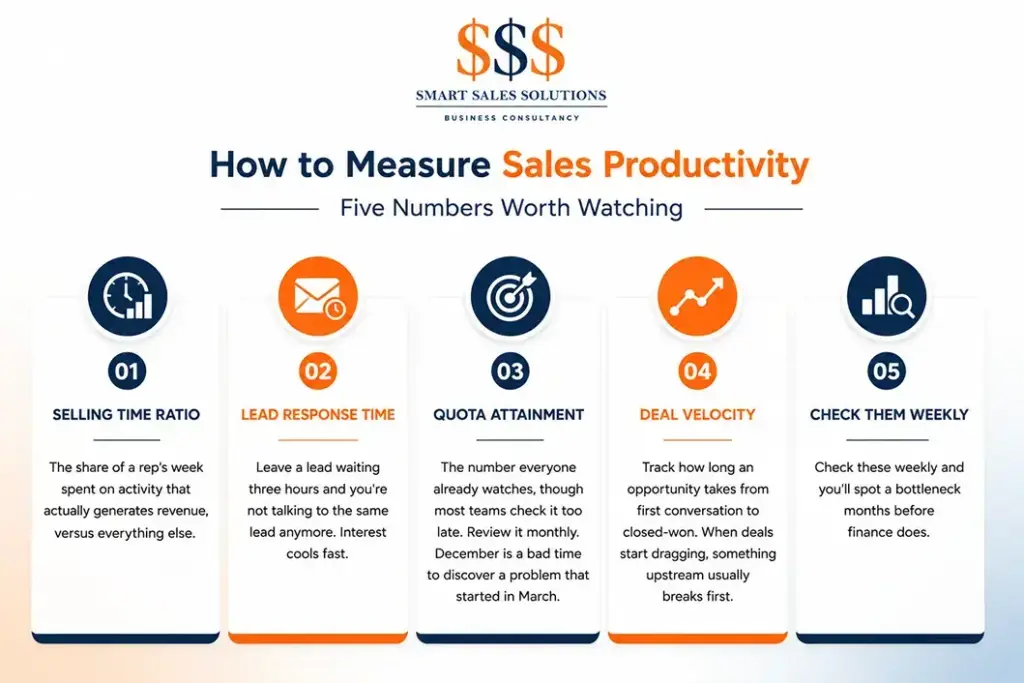
4. How to Measure Sales Productivity (Five Numbers Worth Watching)
- Fixing a problem you never measured is guesswork. Fortunately, four numbers carry most of the signal.
- Selling time ratio comes first. This is simply the share of a rep’s week spent on activity that actually generates revenue, versus everything else.
- Lead response time deserves more attention than it usually gets. Leave a lead waiting three hours and you’re not talking to the same lead anymore. Interest cools fast.
- Quota attainment is the number everyone already watches, though most teams check it too late. Review it monthly. December is a bad time to discover a problem that started in March.
- Deal velocity rounds it out. Track how long an opportunity takes from first conversation to closed-won. When deals start dragging, something upstream usually breaks first.
Check these weekly and you’ll spot a bottleneck months before finance does.
5. The Sales Productivity Tools Worth Paying For in 2026
One pattern comes up in almost every team I look at. Someone buys whatever tool is getting buzz that quarter, then wonders why nothing changed. The bottleneck should pick the tool. Not the trend.
CRM and pipeline management is the foundation everything else sits on. Without one place that holds the truth about your customers, every other tool just becomes another disconnected silo. Smart Sales Solutions’ CRM and pipeline platform keeps leads, deals, and follow-ups in a single dashboard instead of scattered across five tabs.
AI-powered lead engagement is where the biggest shift is happening this year. An AI conversation agent that replies to an inbound lead within seconds, instead of hours, changes the math on conversion entirely. Speed alone can outperform a bigger tech budget. Smart Sales Solutions’ AI Employee is built for exactly this: instant replies, appointment booking, and answering the questions a lead has before a rep even sees the message.
Workflow automation exists to absorb the repetitive stuff. Follow-up emails, data entry, stage updates. Once a sequence is tied to a pipeline stage, it fires on its own, and nobody has to remember anything.
Reporting and analytics turn a mess of activity into an actual decision. Skip this piece, and managers end up coaching based on gut feel instead of what’s really happening in the pipeline.
Reputation and communication tools get overlooked constantly, but they matter earlier than people think. Prospects check reviews before they ever pick up your call. Patchy ratings or slow replies can quietly end a deal that technically never started.
6. How to Improve Sales Productivity Without Adding Headcount
Hiring is the expensive answer. It’s rarely the right first move. Try this sequence instead.
Start by auditing where the time actually goes. Track one full week per rep, no shortcuts. Most managers are surprised, sometimes uncomfortably, by how little of that week actually touches a real prospect.
Cut the number of tools before you add a new one. Consolidate whatever overlaps first.
Automate the first response. A new lead deserves an answer in seconds. Whether a bot sends it or an AI assistant drafts it matters far less than the fact that nobody sat on it until Thursday.
Write the sales process down. If every rep is improvising their own version of the pipeline, you don’t have a process, you have five processes wearing a trench coat.
Coach using the four metrics above, not instinct. Look at exactly where a rep is losing deals, and coach that specific stage.
Defend selling hours on the actual calendar. Give admin work a fixed window, maybe an hour after lunch, and refuse to let it leak into prospect time.
Each step compounds the last. Pressed for time? Start with a lead response. Nothing else pays off as quickly, because a faster reply changes whether a lead converts at all.
7. The Mistakes That Quietly Drain Sales Productivity
New software rarely fixes a broken process. Most of the time it just adds another login on top of the same broken process.
Treating every lead like a hot one burns hours on people who were window-shopping at best. Qualify first.
Rolling out a tool without training it means it gets used for two weeks and then quietly abandoned.
Piling on too many changes at once is its own trap. Teams can usually absorb one shift well. Throw three at them simultaneously, and don’t be surprised when none of them stick.
And measuring the wrong thing might be the most common mistake of all. A dashboard full of call volume looks impressive, but it means nothing if those calls aren’t moving deals forward.
8. The Case for One Platform Instead of Five
Here’s an uncomfortable truth most sales leaders don’t want to hear: your team probably doesn’t have a tool problem. It has a too-many-disconnected-tools problem, and those are very different things to fix.
Each new platform brings its own login, its own learning curve, and one more database drifting out of date. Picture the chain: a CRM that can’t see your email tool, an email tool blind to your ad platform, an ad platform with no idea your booking calendar exists. Call that a tech stack if you like. That’s a part-time maintenance job.
Internal onboarding data from businesses using Smart Sales Solutions’ platform backs this up. Once teams run their CRM, AI lead engagement, and automation from a single system, lead response times that used to sit at several hours routinely drop below a minute. For local service businesses, we haven’t found a faster lever on quota attainment than that one change
That’s also why more than half of sales ops professionals are actively consolidating their tech stack this year. This isn’t a passing trend. It’s a correction to years of buying tools without a plan.
If your team is still stitching together a CRM, a scheduling app, an email platform, and a review management tool separately, that patchwork is the bottleneck. Not your reps. See how Smart Sales Solutions replaces that whole stack with one platform.
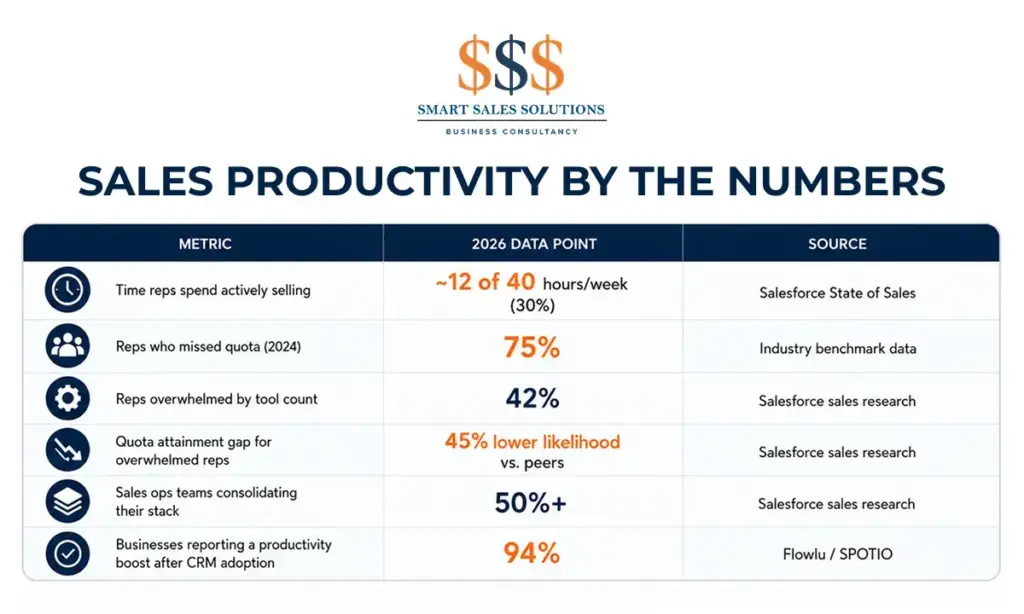
9. Sales Productivity by the Numbers (2026 Data Table)
| Metric | 2026 Data Point | Source |
| Time reps spend actively selling | ~12 of 40 hours/week (30%) | Salesforce State of Sales |
| Reps who missed quota (2024) | 75% | Industry benchmark data |
| Reps overwhelmed by tool count | 42% | Salesforce sales research |
| Quota attainment gap for overwhelmed reps | 45% lower likelihood vs. peers | Salesforce sales research |
| Sales ops teams consolidating their stack | 50%+ | Salesforce sales research |
| Businesses reporting a productivity boost after CRM adoption | 94% | Flowlu / SPOTIO |
10. FAQs
What is the difference between sales productivity and sales efficiency?
Productivity looks at what came out the other end, deals closed and revenue booked. Efficiency looks at how well the team used its time and budget to get there. You can have one without the other.
How do you calculate sales productivity?
Divide total revenue by your rep count and you have average revenue per rep, which is the fastest version of the math. Teams wanting more detail slice it by hours worked or by lead-to-customer conversion.
What hurts sales productivity the most?
Two things, mainly. Tool sprawl and slow lead response. Each disconnected app adds a little drag, and a lead left waiting loses a bit of intent with every passing hour.
Can small businesses improve sales productivity without hiring more reps?
In most cases, yes. Trim the tool count, speed up the first reply, and document how deals are supposed to move. Those three fixes usually outperform a new hire, and they cost a lot less.
What tools actually improve sales productivity in 2026?
Start with a connected CRM. Add AI-powered lead engagement, workflow automation, and a reporting dashboard. If all of that can live inside one platform rather than four separate logins, better still.
11. Where to Go From Here
Most sales teams don’t need another app. They need one platform that replaces the six they’re already juggling.
Or talk to our team about what’s actually slowing your sales process down.
Related Posts