Nobody warns you about the Friday afternoon problem.
You spend good money getting leads through your door. Someone fills out your contact form at 3pm. Then another at 4pm. You are knee-deep in a job, a meeting, a delivery. You tell yourself you will follow up Monday morning. By Monday, one of them has already signed with someone else. Not because that business was better than yours. Simply because they replied first.
That is the gap sales engagement platforms were built to close.
Sales engagement covers every interaction between your business and a prospect from first contact through to closed deal. A dedicated platform automates that process across email, SMS and calls so leads get a response immediately, not when you remember to send one.
Table of Contents:
- Why your CRM is not doing the full job
- What the market numbers tell us about 2025
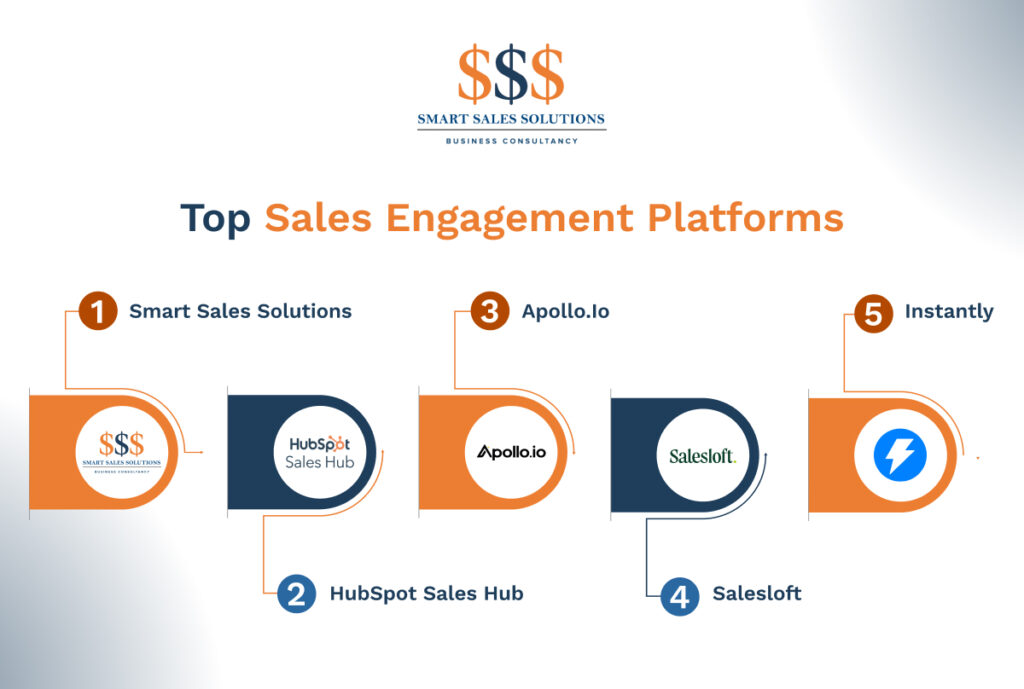
- Five platforms worth your attention this year
- What to actually check before committing
- CRM versus sales engagement clearing up the confusion
- Why Smart Sales Solutions works differently for small teams
- Common questions answered plainly
- Final thoughts
Your CRM Records Leads. It Does Not Win Them.
Here is something worth saying plainly because most software guides skim past it.
A CRM is a record-keeping tool. It stores your contacts, notes the stage of each deal, and logs whatever your team enters manually. It was designed to help you track what happened, not to make things happen. That is an important distinction.
When a prospect fills in your enquiry form on a Saturday morning, your CRM notes it faithfully. It does not send a reply. Or, it does not ask a qualifying question. It waits, perfectly organised, until someone opens it on Monday and decides to take action.
Sales engagement software is the part that actually reaches out. It sends the response on Saturday morning. And, it follows up if there is no reply by Saturday afternoon. It books a call for whenever the prospect is available, and it logs everything back into your CRM automatically.
My favourite way to think about it: your CRM is your notebook, your engagement platform is the work that follows from what you wrote down. Both matter. But only one of them grows your revenue.
Research from Global Growth Insights shows 62% of US sales teams now run customer communication through an engagement platform. Among the smaller businesses I speak with, most are still managing this with a shared inbox and good intentions. That gap is costing them.
What the 2025 Numbers Are Actually Telling Us
The sales engagement platform market hit $9.14 billion in 2025. By 2035, Global Growth Insights projects that figure reaching $21.96 billion. Markets do not double in a decade without a real reason behind them.
For small businesses specifically, three findings from Global Growth Insights stand out:
54% of organisations saw genuine productivity gains after building engagement workflows into their sales process. Teams that ran outreach across multiple channels got around 53% stronger response rates than those sticking to email only.
Over at G2’s Sales Engagement Software category, more than 4,000 verified reviews point to consistent ROI across the main platforms, with analysts putting the market on track for $55.7 billion by 2034. That level of user validation across that many businesses is hard to argue with.
The story these numbers tell is straightforward. Businesses that respond faster and follow up more consistently win more customers. The technology to do that at scale is now affordable enough for a team of five.
Five Platforms Worth Knowing About in 2025
I want to be clear about how I put this list together. Most comparisons like this one are written from the perspective of a company running a 50-person sales floor. This one is not. Each platform below gets evaluated on a single question: would it actually help a small business owner who is already stretched thin?
- Smart Sales Solutions: The all-in-one pick for local businesses
Full disclosure: this is the platform behind this blog. That said, the value case is real. Smart Sales Solutions brings together CRM, AI-powered lead engagement, email and SMS automation, reputation management and local SEO under one login. The monthly cost is $499, which replaces a collection of separate tools that would individually run past $1,575.
The feature that makes the biggest difference for most small businesses is the AI Employee. It picks up every new enquiry straight away, qualifies the lead, answers basic questions and books appointments automatically. A client based in Detroit cut their lead response time from over 12 hours down to under 2 minutes after making the switch. No extra staff. No missed weekends.
- HubSpot Sales Hub: Solid, but the price stacks up fast
HubSpot is a well-built product. Its sequencing, pipeline management and reporting tools are genuinely useful, and the starting price of $45 per month looks accessible. The problem is that most of what a growing SMB actually needs sits behind higher-tier plans. By the time you have added what you need, the monthly cost has climbed well past $200.
- Apollo.io: Strong for prospecting, thin on everything else
Apollo.io does lead enrichment and outbound sequencing well. It finds contacts, fills in missing data and helps you run structured email campaigns. Where it falls short is scope. You still need a separate CRM, a reputation tool, and a website platform alongside it. For pure B2B prospecting as a standalone task, it is solid. As a complete front-end sales solution for a small business, it leaves gaps.
Salesloft: Designed for enterprise, priced accordingly
Salesloft got a lot more interesting after the Clari merger. Revenue intelligence, forecasting, pipeline visibility, it’s a serious platform for serious teams. The price reflects that. Negotiated contracts land somewhere between $83 and $125 per user per month, and once you bolt on the dialer, data, and social automation that don’t come standard, a 25-user team is spending somewhere north of $130,000 a year. If you have a RevOps function and a budget to match, it makes sense. If you don’t have both, the math gets uncomfortable fast.
Instantly: Cheapest entry point if email is your only channel
At $37 per month, Instantly handles high-volume cold email efficiently and keeps deliverability rates up. If cold email is genuinely your whole outbound strategy right now, it covers that job well. It does not offer CRM functionality, SMS, call tools or reputation management. You will outgrow it quickly if your operation involves more than email campaigns.
Seven Things to Verify Before You Commit to Anything
Sales demos show you the best version of a product. Here is what to look for behind that.
- Can it reach prospects beyond email? SMS typically sees far higher open rates than email in most service industries. If your platform handles only one channel, you are leaving response rates on the table.
- Does it update your CRM without manual input? Every interaction your team has with a prospect should sync automatically. Manual updating is where important details quietly disappear.
- Will it follow up without you having to start it? Sequences that trigger based on a prospect’s behaviour, not your availability, are what separate a good platform from a genuinely useful one.
- Does it handle appointment scheduling end-to-end? The back-and-forth of finding a meeting time wastes more hours per week than most business owners track. The AI tools that handle this fully make a measurable difference.
- Does it monitor your online reviews? Your star rating on Google affects whether a lead even bothers contacting you. A platform that watches and responds to reviews automatically protects that pipeline before it starts.
- What does the reporting actually surface? Open rates tell you something. What you need to know is where in your follow-up sequence you are losing people and why.
- What is genuinely included at the base price? Some platforms lead with an accessible entry price and gate the useful features behind premium tiers. Read the pricing page carefully before the demo, not after.
CRM and Sales Engagement: You Need Both, Not Twice the Bill
This question comes up constantly, so here is a plain answer.
Your CRM holds your records. Your sales engagement platform takes action on them. A business needs both functions to run properly. What it does not need is two separate subscriptions, two sets of login credentials, and two customer support queues to navigate when something goes wrong.
When a prospect reaches out on a Tuesday afternoon, a CRM records it. What happens in the next four hours determines whether that prospect becomes a customer or a missed opportunity. A good engagement platform sends a personalized response almost immediately, schedules a follow-up for Thursday if there is no reply, and gets a call booked before the weekend.
TurboCRM inside Smart Sales Solutions handles both sides from one place. Contact management, pipeline tracking and automated outreach sit together, which means no data slipping between platforms and no time spent manually keeping two systems in sync.
Why Smart Sales Solutions Operates Differently
HubSpot, Salesloft and Outreach were all designed with a specific customer in mind. That customer has a dedicated sales team, a RevOps function, a training budget and an IT person. For large organisations, those tools fit well.
For a landscaping company in Ohio, a two-chair dental practice in Michigan, or a small marketing agency managing ten clients, they fit poorly and cost too much.
Smart Sales Solutions was built around a different reality. The people using it are usually running sales, operations and customer service at the same time. They need the platform to work without a specialist configuring it, without a multi-year contract, and without their monthly bill doubling every time they bring on an extra team member.
The AI Employee handles inbound enquiries from the moment they land. It qualifies the lead, answers common questions and books appointments into your calendar, all without staff involvement. That Detroit client mentioned earlier went from spending the first hour of every Monday morning catching up on weekend enquiries, to finding those leads already qualified and scheduled when they arrived at the office.
At $499 per month, the platform covers what you would otherwise pay across Salesforce, ClickFunnels, Mailchimp, Calendly, Birdeye and Google Analytics separately. That individual stack runs past $1,575 per month. Same outcomes, one tool, less than a third of the price.
Common Questions, Answered Without the Marketing Spin
What does sales engagement actually mean day-to-day?
It means your business has a reliable system for following up with leads without you having to remember to do it manually. Someone enquires, your platform responds, follows up if needed, and books them in. You find out about it when there is a confirmed appointment in your calendar.
Is this just another name for a CRM?
No, they do different jobs. A CRM stores information. A sales engagement platform acts on it. For small businesses, the ideal situation is one tool that handles both, which avoids paying for two products and managing two systems.
Is this worth it for a small team?
Global Growth Insights found 59% of organisations reported real productivity improvements after building engagement workflows into how they work. For businesses where the owner is still following up manually, the impact tends to be felt quickly and clearly.
What does it cost for a small business?
Depending on what you need, expect anywhere from $37 per month for email-only tools up to $499 per month for a platform that replaces your CRM, email marketing, reputation management and local SEO together. For most small businesses, the all-in-one option works out cheaper than running separate tools.
Which option suits a local service business best?
Smart Sales Solutions was designed specifically for businesses that serve local customers and need every lead to count. The combination of CRM, AI engagement, reputation monitoring and local SEO at a flat monthly price fits that kind of operation better than an enterprise product adapted down.
Where This Leaves You
Running a small business in 2025 is genuinely competitive. Your customers have options. They move quickly. The businesses winning their attention are not necessarily better than yours, they just respond faster and follow up more consistently.
Sales engagement is how you close that gap without hiring extra staff to manage it.
The market has grown past $9 billion because the results are real and the tools are now genuinely accessible to businesses of any size. Most of the platforms on this list were not built with your kind of operation in mind. One was.
If you have ever lost a lead to a competitor simply because they got back to the prospect first, Smart Sales Solutions was built to make sure that does not keep happening.
Find out exactly where your leads are going
A free Snapshot Report takes under two minutes. It shows you precisely where your business is losing revenue and what to prioritise first. No sales call required, no credit card needed.