Table of Contents
- What Is Consistent Revenue Growth and Why Most Businesses Miss It in 2026?
- Fix Your Sales Pipeline Before You Spend Another Dollar on Ads
- AI-Powered Lead Engagement: Revenue Growth Starts in the First 5 Minutes
- Reputation Management Is a Revenue Strategy, Not a PR Task
- Replace Scattered Tools with One Integrated Growth Platform
- Turn Existing Customers Into Your Strongest Revenue Channel
- FAQs About Revenue Growth
- Conclusion
Nobody warned you that running a small business would feel like being the last person standing in a game nobody explained the rules to.
You show up, you serve your clients well, you pour time and money into marketing, and yet the revenue numbers stay unpredictable. Good one month. Worrying about the next. No clear reason why.
Here is what I have observed working with small business owners across service industries: the problem is almost never effort. It is almost always infrastructure. Specifically, the absence of a repeatable system that captures revenue whether you are there managing it or not.
McKinsey spent years studying over 5,000 companies and found that only one in eight ever achieves consistent annual revenue growth above 10 percent. For small business owners, that finding lands differently. There is no board of directors to answer to. The consequences are personal.
So this guide is written for the owner who is tired of the plateau. Let’s get into it.
1. What Is Consistent Revenue Growth and Why Most Businesses Miss It in 2026?
Revenue growth that is truly consistent does not come from a great promotion or a good quarter. It comes from something boring: a repeatable process that works every single time, regardless of season, staff changes, or market conditions.
I hear this from owners regularly. February crushed it. March was a mystery. The revenue was there and then it wasn’t, and nobody could explain the gap.
That inconsistency is the symptom. The missing system underneath it is the actual disease.
PwC’s research on high-performing organizations found something worth paying attention to. The companies that grow year after year do not win because they find better tactics. They win because they build what the researchers called a “growth system,” a set of connected capabilities that produces results regardless of what the market throws at them. Systems compound over time. One-off campaigns do not.
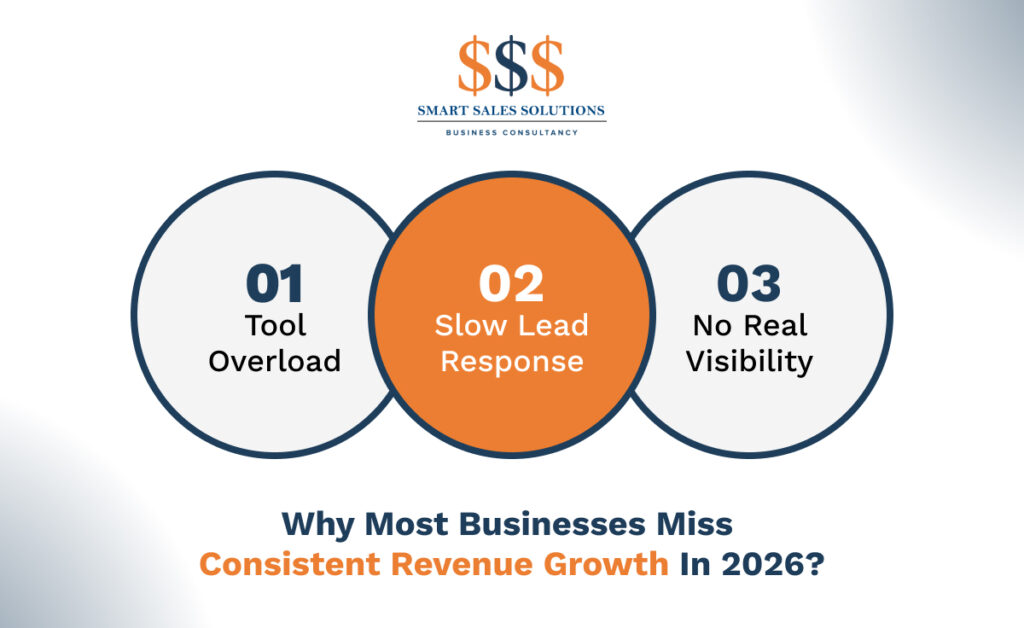
For small businesses in 2026, three specific things keep getting in the way of that kind of growth.
- Tool overload is the first one.
Walk into most SMBs and you will find somewhere between eight and twelve active software subscriptions. A CRM nobody fully uses. An email platform from three years ago. A review management app downloaded during a slow Tuesday that nobody opened since. A social scheduler that still has posts queued from last quarter. None of these tools share data. Leads go untracked. Customers fall through gaps that nobody even knows exist until one of them calls to complain.
- Slow lead response is the second blocker.
Speed-to-lead research has been saying the same thing for years now: contact a new lead within five minutes and you are roughly 100 times more likely to actually reach them compared to waiting 30 minutes. Most small business teams respond in hours. Some the next morning. By that point the customer had already booked with someone else and moved on.
- No real visibility is the third problem.
Without unified reporting, most owners make marketing budget decisions based on what feels productive rather than what the data actually confirms. That is an expensive habit.
Addressing all three serious and predictable revenue growth stops feeling like a lucky outcome.
2. Fix Your Sales Pipeline and Revenue Growth Follows Naturally
Your sales pipeline is where revenue either gets captured or quietly disappears. Most owners focus on driving more traffic and more leads, which makes sense on the surface. The smarter play, though, is to stop losing the leads already coming in.
Here is what a working pipeline actually looks like day to day.
Every single inquiry, regardless of where it comes from, enters through one documented system. Website form, Google Business Profile call, Facebook message, after-hours voicemail, it all flows into the same place. That lead receives an immediate response. Not when someone checks the inbox. Not after lunch. Right away.
From there, a clear sequence takes over: initial engagement, qualification, appointment booking, follow-up, and close. Anything repeatable gets automated. Anything requiring genuine human judgment gets a person.
CloudTalk’s 2026 CRM research puts a number on how bad the current situation is: up to 25 percent of lost leads can actually be recovered just by improving CRM workflows. Yet 75 percent of businesses never use their CRM to anywhere near its actual capability, letting revenue bleed out through poor follow-up week after week.
Three out of four competitors you are up against right now share that same weakness. That is not a small opening. That is a wide one.
Go through every channel where a new inquiry can reach your business this week. Count the ones with an automated follow-up already in place. Every gap you find is a revenue opportunity your sales pipeline is currently missing.
3. AI-Powered Lead Engagement: Revenue Growth Starts in the First 5 Minutes
There is a number that genuinely changes the way you should think about lead handling. Research shows that 78 percent of customers end up buying from whichever business reaches them first. Not the one with the best offer. Not the one with the best reviews. Simply the first one to respond.
Think about what that means for how you currently handle incoming inquiries.
An AI Employee changes the math entirely. When a lead comes in at 2pm on a Wednesday or 11:30pm on a Friday, it gets a real conversational response immediately, before anyone on your team has seen the notification. The AI books appointments, handles common questions, qualifies the prospect, and passes the conversation to a human when that stage actually calls for one.
DemandSage’s 2026 CRM statistics back this up with hard numbers: businesses that integrate AI automation with their CRM see conversion rates jump by 300 percent, and the return on investment consistently lands between three and five dollars for every dollar put in.
For a local dentist, HVAC company, or law firm, one additional appointment per day closes into meaningful annual revenue fairly quickly. The AI Employee from Smart Sales Solutions is purpose-built to capture those inquiries the moment they arrive, before a competitor’s team even wakes up to see them.
4. Reputation Management Directly Impacts Your Revenue Growth Rate
Your online reputation is not a brand protection issue. It is a lead generation issue, and most business owners have not fully made that connection yet.
Step into your own customer’s shoes for a second. They need an HVAC technician and they search Google. Three local businesses come up. One shows 4.8 stars across 200 reviews. Another has 3.9 stars and fourteen reviews. The third has nothing visible at all.
Nobody agonizes over which one to call.
Google’s ranking algorithm actively favors businesses that accumulate reviews consistently, keep them recent, and respond to them. When your review count goes up, your local search ranking goes up. When your ranking improves, more people see your listing before they see a competitor. That sequence from review volume to visibility to inbound calls is a direct revenue growth mechanism, not a soft marketing benefit.
Staying on top of your reputation is not damage control. It is building a pipeline of warm, pre-qualified leads who already feel comfortable with you before they ever make the first call.
5. Replace 12 Scattered Tools with One Platform Built for Revenue Growth
Let me walk you through the math that most business owners never actually sit down and add up.
A standard CRM subscription runs about $99 per month. Email marketing is another $99. Workflow automation tools generally start around $169. Add reputation management at $159, social media management at $99, and an SEO platform at $199. You are already above $824 per month before you have covered everything a growing business actually needs.
Now consider that none of those tools share data with each other by default. Your sales team works from information your marketing team never sees. Customer service is solving problems that never made it into your CRM. Every month you are paying for seven platforms that create six data silos and zero unified visibility.
Smart Sales Solutions brings all of that into one platform at $499 per month. Your tools communicate directly. Your pipeline sits in one view. Everyone on your team operates from the same information at the same time.
2026 CRM industry research from Automatic Backlinks found that businesses aligning CRM strategy with clear KPIs are 56 percent more likely to outperform competitors on customer satisfaction, and they are far more likely to report sustained double-digit revenue growth year over year.
Consolidating your stack is not just about trimming the monthly bill. It removes the structural gaps where revenue disappears without anyone noticing.
6. Turn Existing Customers Into Your Strongest Revenue Channel
Bringing in a new customer costs roughly five times more than keeping one you already have. Most business owners know this statistic. Most still funnel the majority of their marketing budget toward acquisition anyway.
That gap between what owners know and how they actually spend is one of the most consistently overlooked revenue leaks in small business.
Harvard Business Review’s retention research found that a five percent improvement in customer retention can produce a 25 to 95 percent increase in profits. That range is wide because it depends on your margins and business model, but honestly even landing at the low end of that range has a serious impact. The mechanism behind it is straightforward. When fewer customers leave, your revenue base grows without requiring a single new acquisition.
Email and SMS marketing automation is the most practical tool for building retention without adding to your workload. You stay in front of past clients between purchases. You send targeted offers to people who already know and trust your business. You request reviews at the exact right moment in the customer journey. You bring back clients who went quiet two or three months ago with a well-timed message.
Each of those touchpoints feeds directly into your local SEO rankings, your referral pipeline, and your repeat revenue numbers. The businesses with the most predictable revenue growth in 2026 are not running larger ad campaigns than everyone else. They are working on the customer relationships they have already built more systematically than their competitors.
FAQs About Revenue Growth
What is a good revenue growth rate for a small business in 2026?
Industry benchmarks generally put 15 to 25 percent annual revenue growth in the healthy range for small businesses, though that varies quite a bit depending on your sector and your starting base. Bank of America’s 2025 Business Owner Report found that 74 percent of small and mid-sized business owners expected revenue growth in the coming year, with nearly 60 percent also planning to expand their operations. Business owners who have AI automation and a properly used CRM in place tend to outperform that baseline by a meaningful amount.
How does CRM software contribute to revenue growth?
Honestly, the most direct contribution a CRM makes is stopping revenue from leaking out of a broken pipeline. It puts all your customer data in one place, automates follow-up so leads do not get forgotten after the first contact, shortens your sales cycle because every team member has the context they need, and gives you the conversion data to see exactly where deals are stalling. SLT Creative’s 2026 CRM research found that businesses implementing CRM systems properly, and aligning them with real business KPIs, can see revenue increases of up to 245 percent.
What is the fastest way to grow business revenue for small businesses?
The fastest win for most small businesses is fixing how incoming leads get handled. The money is usually already there in the form of inquiries that went cold or never got a proper follow-up. Most businesses lose potential customers not because those people chose a competitor with better services, but simply because nobody responded fast enough. Getting AI-powered lead engagement working alongside a CRM will almost always show a faster return than launching a new advertising campaign.
How can I achieve consistent revenue growth without increasing ad spend?
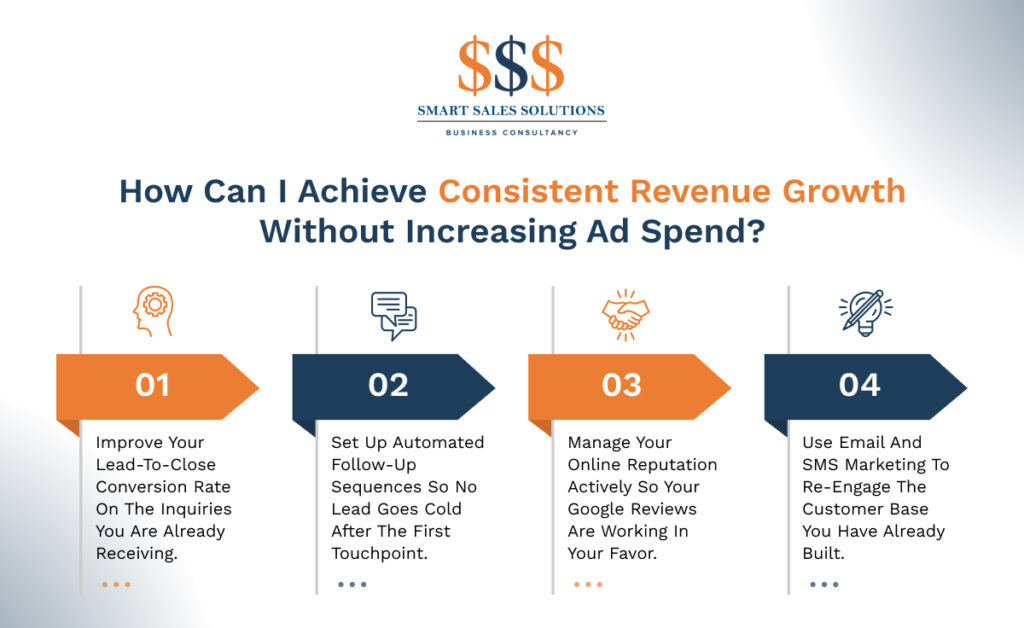
Work on four things inside your current operation. Improve your lead-to-close conversion rate on the inquiries you are already receiving. Set up automated follow-up sequences so no lead goes cold after the first touchpoint. Manage your online reputation actively so your Google reviews are working in your favor. And use email and SMS marketing to re-engage the customer base you have already built. These four moves grow revenue from within rather than requiring a bigger acquisition budget.
Conclusion: Revenue Growth Is a System, Not a Strategy
The businesses that build real, lasting revenue growth in 2026 are not the ones outspending everyone else on advertising.
They are the ones that built something more durable: a system where leads get captured the moment they arrive, follow-ups happen on schedule without anyone remembering to do them, customers stay engaged long after the first transaction, and every dollar spent on marketing ties back to a trackable outcome.
If your revenue feels unpredictable right now, throwing more money at ads will not solve the structural problem underneath it. What actually solves it is building the infrastructure that makes growth reliable, and that is exactly what Smart Sales Solutions was designed to do for small businesses.